


Front Width vs. Back Width for Trapezoid Cushions
If you are ordering a trapezoid cushion for a bay window, breakfast nook, banquette, angled bench, RV dinette, or tapered chair seat, the most important measurement is not simply width. It is knowing which width is the front and which width is the back.
A trapezoid cushion can be made to fit beautifully, but it is directional. If the front width and back width are swapped, the cushion may technically have the right numbers and still sit the wrong way. That is why the front width vs back width question matters so much before you choose fabric, fill, edge style, or zipper placement.
For built-in seating especially, the goal is not to make a standard rectangle work. The goal is to match the actual architecture: angled bay window walls, a tapered breakfast nook bench, a clipped-corner window seat, or a mudroom bench with an odd cutout.
Replacing Your RV Dinette Cushions?
Replacement dinette and bunk cushions built to your camper's exact measurements, with high-density foam and removable zippered covers you can pull off and wash.
Design Your RV Cushions →What front width and back width mean on a trapezoid cushion
On a trapezoid cushion, the front width is the edge closest to the person sitting down. It usually faces the room, walkway, dining table, or open side of the seat.
The back width is the edge farthest from the person sitting down. It usually sits against the wall, window, backrest, or inside corner of the built-in seating.
The front is not automatically the wider edge. The back is not automatically the narrower edge. In many bay window seats, the front width may be wider because the window angles taper inward toward the glass. In some furniture frames, the back width may be wider instead. Always label the edges based on how the cushion will sit, not on which number is larger.
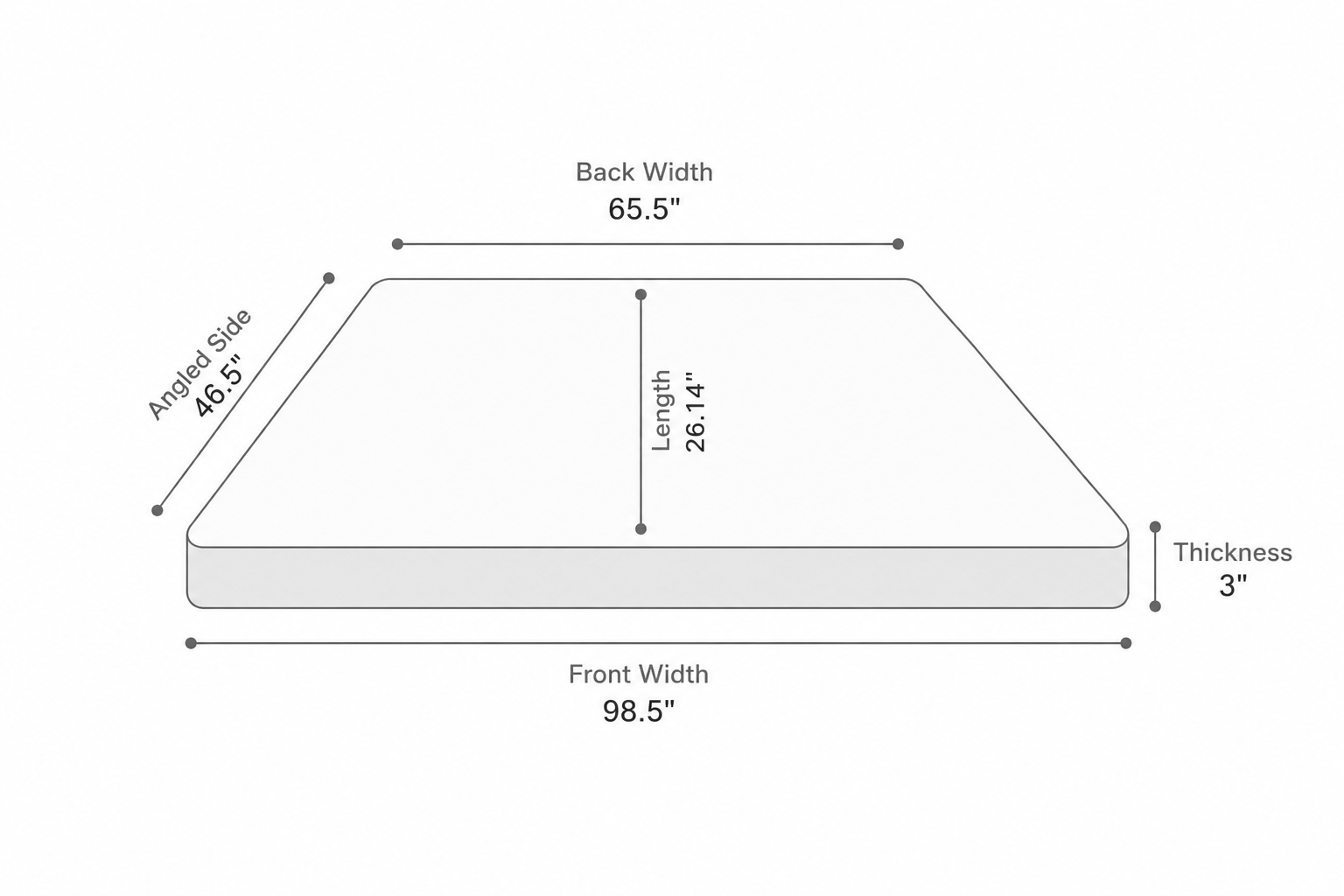
| Measurement | What it means | Common location |
|---|---|---|
| Front width | The room-facing or knee-facing edge | Open side of a bay window seat, banquette, bench, or chair |
| Back width | The wall-facing or backrest-facing edge | Against windows, walls, backs, or inside rails |
| Depth | The distance from the front edge to the back edge | Measured front to back, usually through the center |
| Angled side | The sloped left or right edge connecting front and back | Along tapered walls, angled furniture arms, or side panels |
A good rule is simple: stand where you would normally sit or approach the seat. The edge nearest you is the front width. The edge against the wall or back support is the back width.
Why trapezoid cushions depend on both widths
A rectangle has one width and one depth. A trapezoid has two widths, and those two widths tell the maker how the cushion tapers. That taper is what lets a custom cushion nest into a bay window bench, fit a corner banquette, or sit cleanly on angular furniture without overhangs and gaps.
This is also why off-the-shelf cushions usually fail in these spaces. A rectangular cushion placed on a trapezoid seat leaves awkward empty triangles at the back, hangs over at the front, or forces you to push and bunch the cushion into place. A made-to-measure trapezoid cushion follows the actual geometry.
One verified customer review describes the result well:
"Wonderful cushion, looks fantastic on the bay window. Dimensions are exactly as requested and everything is of the highest quality. Thank you for adding a finished look to our bay window."
If your seat includes clipped corners, wall returns, radiator clearances, or trim cutouts, the shape may need more than a simple front width and back width. For a tapered seat with clipped front or rear corners, a Custom Clipped Trapezoid Seat Cushion is often the more accurate starting point than trying to force the dimensions into a basic trapezoid.
How to decide which side is the front
Before measuring, make a quick top-down sketch of the seat. It does not need to be pretty. It only needs to show the wall side, the open side, and any angled or clipped edges.
Mark the open, room-facing edge as front. Mark the wall-facing or backrest edge as back. Then stand in the room and compare your sketch to the actual seat. This small habit prevents the most common trapezoid mistake: rotating the cushion on paper without realizing it.
For built-in seating, use these cues:
- If it is a bay window cushion, the front is usually the straight edge facing the room.
- If it is a breakfast nook or banquette, the front is usually the edge facing the table.
- If it is a mudroom or entryway bench, the front is usually the edge facing the walkway.
- If it is an RV dinette cushion, the front is usually the edge where your knees face when seated.
- If it is an angled chair or outdoor furniture seat, the front is usually the edge you see first when approaching the chair.
If you are still unsure, take a photo from above, label front and back on the photo, and contact ZIPCushions by chat, phone, or email before ordering. Human help is especially useful when one side is clipped, one wall is not square, or the cushion needs to clear trim, a post, or a radiator.
How to measure front width vs back width correctly
Measure the actual seating surface whenever possible, not an old cushion that may be compressed, stretched, curled, or distorted. Use a firm tape measure, keep it straight, and measure to the nearest usable dimension requested on the product page.
Measure the front width
Place the tape along the front edge of the seat, from the left front corner to the right front corner. This is the edge closest to the room, table, walkway, or knees. Write it down as front width immediately so it does not get confused with the back width later.
For a built-in bay window seat, this may be the long straight edge that faces the room. For a tapered chair seat, it may be the edge between the two front corners of the frame.
Measure the back width
Now measure the back edge, from the left back corner to the right back corner. This is usually the edge against the windows, wall, or back rail. Write it down as back width.
Do not assume the back width should be smaller. Let the actual seat decide. Some trapezoid spaces taper inward, while others flare outward.
Measure the depth
Depth is the front-to-back distance. On a trapezoid, measure from the center of the front edge straight back to the center of the back edge unless the product instructions ask otherwise. If the left and right sides are irregular, make a note and ask for help rather than averaging aggressively.
Confirm the left and right angled sides
The angled side edges connect the front and back widths. If the seat is symmetrical, both side angles may match. If it is an older built-in, a bay window, a boat seat, or an RV dinette, one side may be slightly different from the other. A labeled sketch can prevent confusion.
For a broader measuring overview across rectangles, trapezoids, L-shapes, and bay windows, ZIPCushions also has a step-by-step custom cushion measuring guide that can help you compare shape types before placing an order.
Common front width and back width mistakes
Most fit problems with trapezoid cushions come from orientation, not from the idea of measuring itself. The tape measure can be accurate, but the cushion can still be wrong if the drawing is unclear.
| Mistake | Why it causes trouble | Better approach |
|---|---|---|
| Calling the widest side the front automatically | The widest side may actually sit against the wall or backrest | Label front by seating direction, not by size |
| Measuring an old cushion | Old foam and fabric can stretch, compress, or bow | Measure the hard seating area when possible |
| Forgetting clipped corners | A clipped trapezoid needs extra shape information | Use a clipped trapezoid shape and provide all requested dimensions |
| Rounding to a standard size | Built-ins are often not standard, even when they look simple | Use the actual measurements requested on the product page |
| Choosing fabric only from a screen | Color can shift in real room light | Order a fabric sample before committing |
That last point is important. Fit is the concern most people feel before buying, but color is often the detail that is hardest to judge from a screen. A linen blend, chenille, velvet, faux leather, performance acrylic, or indoor/outdoor fabric can look different in morning light, under warm bulbs, or beside painted trim. If your cushion will sit in a visible bay window, reading nook, dining banquette, or entryway, ordering a sample first is the safest way to judge color and texture in the actual room.
How this applies to bay windows, benches, and angular furniture
A bay window seat is the classic place where front width vs back width becomes confusing. Many bay windows have a wider front edge facing the room and a narrower back edge following the window wall, but not all do. Some are shallow, some are deep, and some include clipped corners at the front where trim or side walls interrupt the shape.
Mudroom benches, entryway benches, and dining banquettes can also require trapezoid measurements, especially in older homes where walls are not perfectly square. A cushion that follows a slightly angled bench top looks intentional. A rectangle on the same bench often exposes the irregularity.
For outdoor angular furniture, the same measuring logic applies, but fabric selection may change. If you are refreshing a tapered patio chair or angled outdoor bench, Sunbrella® Trapezoid Custom Seat Cushions are relevant for trapezoid-shaped outdoor seating where a standard rectangle will not sit cleanly. The measurement question is still the same: decide which edge is front, which edge is back, then measure the actual frame.
RV dinettes and boat seating are another place where the front and back widths matter. These seats are often compact, tapered, and built around walls, cabinets, or tables. A small orientation mistake can make the cushion feel crooked because there is very little extra room to hide it.
After the measurements, think about the cover
Once the front width, back width, depth, and angled sides are clear, the construction choices become easier. ZIPCushions is built around removable zippered covers, which is especially helpful for built-in seating that gets daily use: breakfast nooks, mudroom benches, reading nooks, piano benches, RV dinettes, and window seats used by pets or children.
Depending on the cushion and use case, you may also consider washable covers according to fabric care instructions, anti-skid or non-slip backing, ties or attachment loops, piped edges, plain edges, and the fill or thickness options shown on the product page. These are finishing decisions, but they work best when the shape has already been measured and labeled correctly.
A verified customer review points to the value of getting an unusual built-in right:
"Exceeded my expectations! I have a mudroom bench with odd cutouts that required a custom cut cushion."
That is the real advantage of measuring carefully. A trapezoid cushion is not just a cushion with slanted sides. It is a way to make awkward architectural seating feel finished, comfortable, and deliberate.
Frequently Asked Questions
Is the front width always bigger than the back width on a trapezoid cushion?
No. The front width is the edge closest to the sitter or room, not necessarily the larger number. Some seats are wider at the front, while others are wider at the back.
What if I accidentally swap the front and back width?
The cushion may be made with the correct measurements but the wrong orientation. On a true trapezoid, that can create gaps, overhangs, or a cushion that seems rotated. Always label a sketch before ordering.
Should I measure the old cushion or the seat itself?
Measure the actual seat surface when possible. Old cushions can compress, stretch, or curve over time, which can make their measurements less reliable.
How do I measure a trapezoid cushion with clipped corners?
A clipped-corner trapezoid needs more information than a basic trapezoid. Label the front, back, left, and right sides, measure each requested edge, and use a clipped trapezoid product option rather than simplifying the shape into a rectangle.
Do fabric samples matter if my measurements are correct?
Yes. Measurements solve fit, but samples help solve color and texture. Fabric can look different on a screen than it does in your actual room light, so ordering a sample first is a smart step before choosing the final cover.
Ready to measure your trapezoid cushion?
Start with the seat, not the old cushion. Label the room-facing edge as front, the wall-facing or backrest edge as back, then measure both widths before choosing fabric or fill. If the shape includes clipped corners, cutouts, or uneven angles, make a simple sketch and ask for help before you order.
ZIPCushions makes custom cushions for seating that standard sizes do not fit, including bay windows, window seats, breakfast nooks, banquettes, mudroom benches, RV dinettes, and angular outdoor furniture. If you are unsure about front width vs back width, contact ZIPCushions through chat, phone, or email, and order fabric samples so the final cushion fits both the seat and the room.


